Tsim
A GPU-accelerated quantum circuit sampler based on ZX-calculus stabilizer rank decomposition. Tsim feels just like Stim, but supports non-Clifford gates.
A detailed description of Tsim is given in arXiv:2604.01059.
Quick Start
An introductory tutorial is available here. For many existing scripts, replacing stim with tsim should just work. Tsim mirrors the Stim API and currently supports all Stim instructions.
Additionally, Tsim supports the instructions T, T_DAG, R_Z, R_X, R_Y, and U3.
import tsim

c = tsim.Circuit(
    """
    RX 0
    R 1
    T 0
    PAULI_CHANNEL_1(0.1, 0.1, 0.2) 0 1
    H 0
    CNOT 0 1
    DEPOLARIZE2(0.01) 0 1
    M 0 1
    DETECTOR rec[-1] rec[-2]
    """
)

detector_sampler = c.compile_detector_sampler()
samples = detector_sampler.sample(shots=100)
Installation
uv add bloqade-tsim
For GPU acceleration, use
uv add "bloqade-tsim[cuda13]"
See Installation for more options.
Architecture
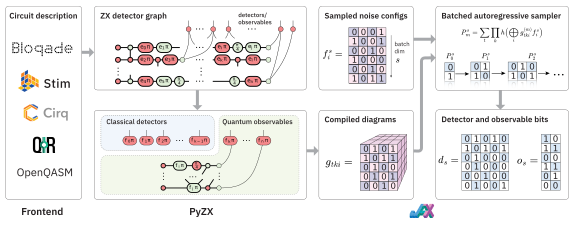
Quantum programs are translated into ZX diagrams in which Pauli noise channels appear as parameterized vertices with binary variables \(e_i\). ZX simplification factors the diagram into a classical part that represents the Tanner graph and a quantum part containing the observable circuit. Both parts define a new basis of error mechanisms \(f_i = \bigoplus_j T_{ij}\,e_j\). The observable diagram is used to compute marginal probabilities for autoregressive sampling. Here, each diagram is decomposed into a sum of Clifford terms via stabilizer rank decomposition, following Sutcliffe and Kissinger (2024), and compiled into binary JAX tensors \(g_{tki}\). At sampling time, JIT-compiled XLA kernels contract \(g_{tki}\) with batched noise configurations \(f_i^{s}\) to evaluate marginal probabilities and autoregressively sample detector and observable bits.
Differences from Stim
Tsim supports non-deterministic detectors and observables. An important consequence is that Tsim will simulate actual detector samples, whereas Stim only reports detection flips (i.e. detection samples XORed with a noiseless reference sample). Concretely,
c = tsim.Circuit(
    """
    X 0
    M 0
    DETECTOR rec[-1]
    """
)
sampler = c.compile_detector_sampler()
samples = sampler.sample(shots=100)
print(samples)
True values, whereas the same circuit would result in False values in Stim. To reproduce the behavior of Stim, you can use the following: samples = sampler.sample(
shots=100,
use_detector_reference_sample=True,
use_observable_reference_sample=True,
)
True, a noiseless reference sample is computed and XORed with the results, so that output values represent deviations from the noiseless baseline. Note that this feature should be used carefully. If detectors or observables are not deterministic, this may lead to incorrect statistics. Benchmarks
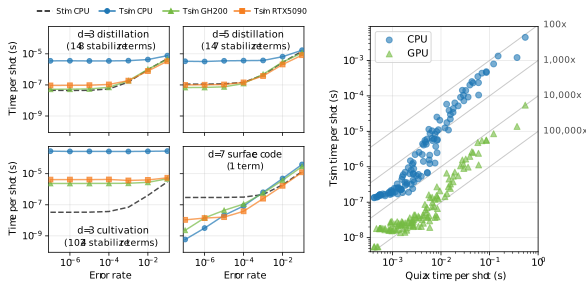
With GPU acceleration, Tsim can achieve sampling throughput for low-magic circuits that approaches the throughput of Stim on Clifford circuits of the same size. The figure below shows a comparison for distillation circuits (35 and 85 qubits), cultivation circuits, and rotated surface code circuits. Tsim can be five orders of magnitude faster than quizx.
Citing Tsim
If you use Tsim, please consider citing the paper describing the core simulation approach:
@article{tsim2026,
  title={Tsim: Fast Universal Simulator for Quantum Error Correction},
  author={Haenel, Rafael and Luo, Xiuzhe and Zhao, Chen},
  journal={arXiv preprint arXiv:2604.01059},
  year={2026}
}