Architecture Overview
This section describes QLAM's system architecture and key design concepts.
System Overview
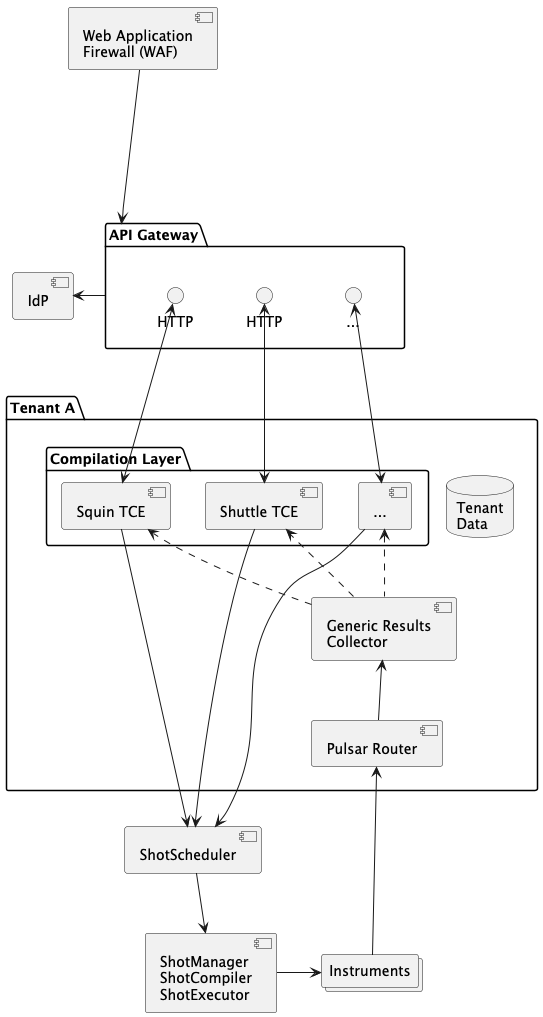
QLAM orchestrates quantum task execution across multiple components:
Network Architecture
The WAF (Web Application Firewall) is the only component exposed to the public internet. All client traffic enters through the WAF, which:
- Terminates HTTPS connections
- Provides DDoS protection and traffic filtering
- Inspects requests for web attacks using OWASP CRS rules
- Routes validated requests to the API Gateway for authentication
All internal communication between services occurs within private networks and does not traverse the public internet.
TCE Overview
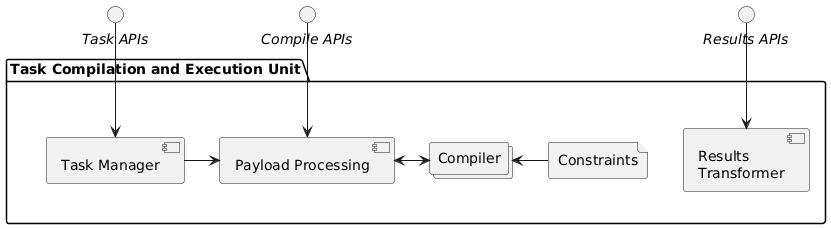
A Task Compilation and Execution (TCE) unit is deployed per QPU mode and contains the services responsible for processing and executing tasks:
Core Components
WAF (Web Application Firewall)
The WAF is the public entry point for all QLAM traffic:
- Only internet-exposed component - All other services are internal
- HTTPS termination - TLS connections terminate at the WAF
- Security enforcement - Rate limiting, DDoS protection, request filtering, OWASP CRS rules
- Traffic routing - Forwards validated requests to the API Gateway (Kong)
See WAF Security Coverage for detailed protection categories and compliance information.
API Gateway
The API Gateway (Kong) handles routing and service mesh functions:
- Routes requests to appropriate backend services
- Applies authentication and authorization policies
- Provides load balancing across service instances
- Handles request/response transformation
Task Manager
The Task Manager is the central orchestration service. It:
- Receives task submissions from the API gateway
- Validates tasks against their definitions
- Routes tasks to appropriate processing pipelines
- Tracks task state through the lifecycle
- Provides task status and results to clients
Payload Processor
The Payload Processor orchestrates task compilation and preparation:
- Receives compilation requests from the Task Manager or direct API invocation
- Routes programs to the Compiler service
- Manages the compilation lifecycle
- Stores compiled artifacts for execution
Compiler
The Compiler performs the actual program compilation:
- Parses quantum programs
- Compiles high-level programs to Flair (hardware instructions)
- Optimizes circuits for target hardware
- Validates hardware constraints
Result Manager
The Result Manager collects and processes execution results:
- Receives raw results from hardware/simulators
- Transforms results to standard formats
- Stores results for retrieval
- Handles result aggregation
- Forwards results on to specific TCE Result Transformer
Result Transformer
The Result Transformer processes and serves results for a specific QPU mode (deployed per TCE):
- Consumes shot results from the Result Manager via Pulsar
- Applies configurable transformations (filtering, formatting)
- Persists transformed results to the TCE database
- Serves results via REST API with pagination and sorting
Communication
QLAM services communicate via:
- REST APIs - Client-facing interfaces
- Apache Pulsar - Internal message queuing between services
Learn More
- QPU Modes - Available execution configurations
- Task Lifecycle - How tasks flow through the system